
Content Intelligence: Taking the Manual Hours Out of Video Metadata
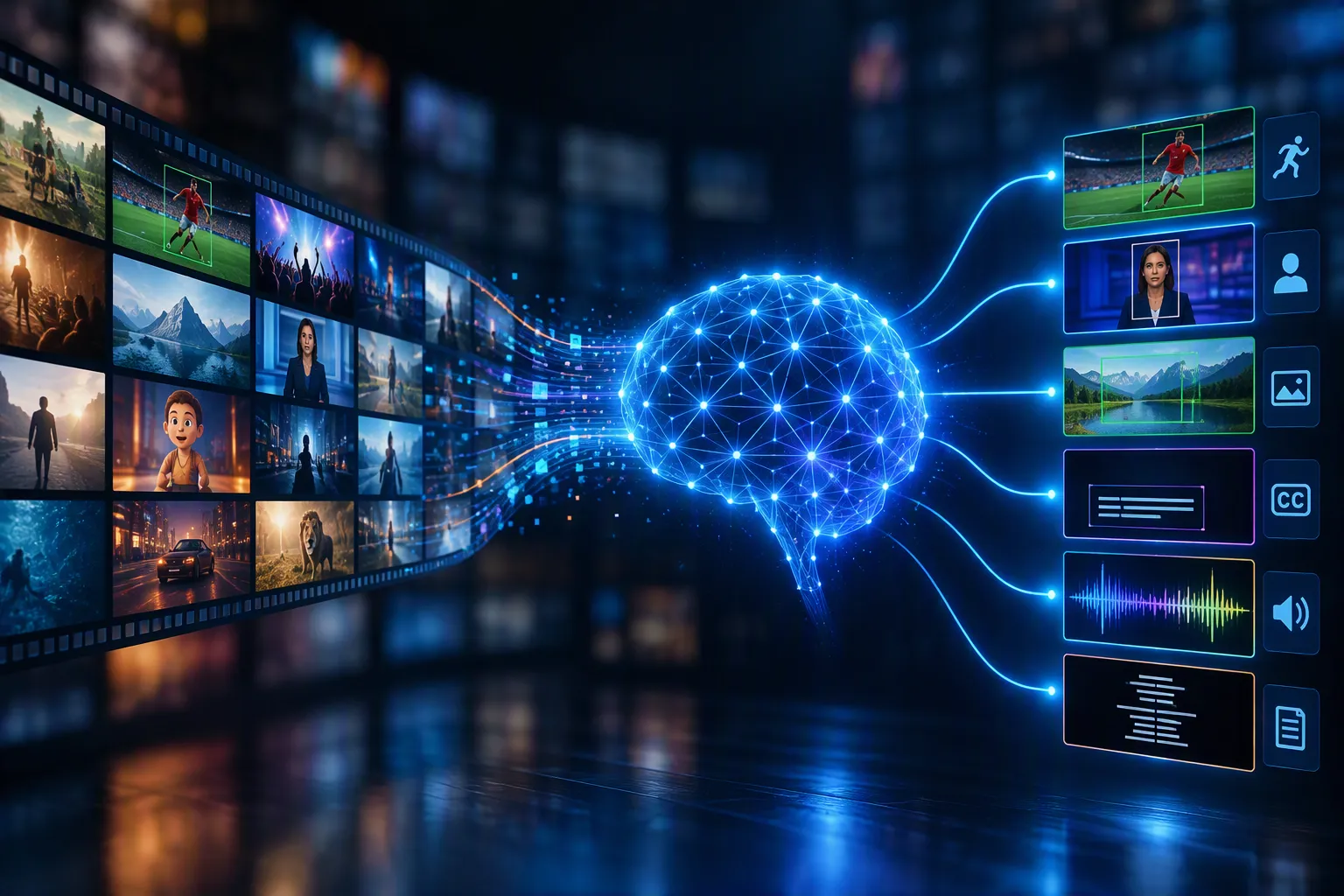
Every file that passes through a broadcaster’s or streaming provider’s workflow carries far more information than its technical metadata reveals. Where does the intro start and end? Is there a recap before the episode? When do the end credits begin? Is a channel logo burnt into the picture? Which language is spoken on each audio track, and are the subtitles actually in sync with it?
This information powers the “Skip Intro” and “Next Episode” buttons viewers expect, decides whether a title can go to a new territory, and prevents errors on air. Yet in most media operations it is still extracted by a person watching the video. Here we look at why that is so expensive, and how deep learning can take most of that work off operators’ desks.
The hidden cost of watching video
Consider a typical content preparation job. An operator scrubs through an episode to find the first and last frames of the opening titles, notes the timecodes, and repeats this for the recap and end credits. Then they check the frame for logos and burnt-in subtitles, verify the aspect ratio, listen to each audio track to confirm its language, and spot-check subtitle timing.
Even for an experienced operator, this takes many minutes per episode. Multiply it by a catalogue of thousands of episodes, daily new deliveries and several versions of every title, and content metadata becomes one of the largest manual workloads in the operation, one that scales linearly: twice the content means twice the operators.
Speed is only half of the problem. Manual marking is repetitive, and repetitive work produces mistakes:
- Boundary errors: an intro out-point marked a second too late means viewers who press “Skip Intro” miss the first line of dialogue.
- Inconsistency: two operators rarely mark the same boundary on the same frame, and one operator’s judgement drifts over a long shift.
- Missed details: a small, semi-transparent logo or a single mislabelled audio track is easy to overlook after hours of screen time.
- Late discovery: errors found after publishing mean re-work and re-delivery.
Why classic automation was not enough
Automating these checks is not a new idea. Traditional approaches rely on hand-written rules: black-frame detection for segment breaks, audio fingerprinting for a repeated theme tune, pixel statistics for letterbox bars. They work on the content they were tuned for and break down on everything else: a cold open, a theme tune that changes every season, a dark drama, or credits rolling over the final scene.
The underlying reason is that these questions are semantic. Recognising an intro requires understanding what an intro is: stylised title cards, a recurring piece of music, fast cutting, and its position in the episode. That is exactly the kind of problem deep learning is good at.
How deep learning approaches the problem
From an engineering point of view, content analysis with deep learning is a pipeline with three stages.
1. Feature extraction. The video is sampled at a few frames per second and each moment is converted into a compact numerical description, an embedding. Vision models describe what is on screen (title cards, credit text, logos), audio models describe what is heard (music, dialogue, silence), and a shot boundary model marks where the editor cut.
2. Temporal segmentation. A single frame is rarely enough to tell the intro from the main content. A temporal model uses attention to weigh each moment against its context across the full episode, and classifies every moment as logo, intro, recap, content, credits or transition. Respecting shot boundaries stops context “leaking” across cuts and keeps segment edges sharp.
3. Post-processing and calibration. Predictions are smoothed, short false detections removed, and boundaries refined to the frame. Then boundaries are calibrated for how they will be used. For Skip Intro, errors are not symmetrical: a Skip button that appears slightly late is harmless, one that skips a second of the story is not. Boundaries are deliberately placed on the safe side.
Other detections follow the same pattern: text recognition reads burnt-in subtitles and slate text, speech models identify spoken languages, and correlating subtitle timing with the dialogue reveals sync drift that spot-checking would miss.
Where deep learning cuts the hours
Applied to a real content workflow, deep learning replaces most of the watching with reviewing. The wins:
- Intro, recap and credits marking: frame-accurate in and out points for Skip Intro, Skip Recap and Next Episode, delivered without anyone scrubbing through the episode.
- On-screen graphics: burnt-in channel and studio logos, burnt-in subtitles, superimposed titles and slates are detected automatically, with slate text extracted.
- Textless material: textless sections appended after the programme are located, ready for localised versions.
- Format checks: letterboxing and pillarboxing are measured to report the true active picture aspect ratio.
- Audio checks: the spoken language of every track is identified, and non-standard Dolby channel mappings are flagged.
- Subtitle sync: subtitles are verified against the audio across the whole file, not just at a few sampled points.
The operator’s role changes from searching to confirming: instead of watching an entire episode, they review detected segments and jump straight to the few that need attention. Every file is checked the same way, at any hour, without end-of-shift fatigue.
Conclusion
Extracting content metadata by eye is slow, costly and error-prone, and it scales only by adding people. Deep learning turns it into an automated, consistent process in which the machine does the watching and the operator makes the final call, freeing skilled staff for the work that really needs them. At Vcodes, we apply these techniques in vCoder DeepSense, our AI video content analysis platform.